

Rogers is not short of money. That is the part worth holding onto, because most of the coverage of Tuesday’s announcement reached for a story about a broadcaster in trouble, and the filings do not support it.
On July 28 Rogers sublicensed Wednesday night national NHL games in Canada to Amazon for 12 years. At least 26 regular-season games a season in English and French, starting September 30, at no extra cost to Prime members, plus two first-round and one second-round playoff series every year. Sportsnet keeps more than 500 national games, Saturday nights, Monday nights and most of the playoffs.
Split Rogers’ own books in two and the trade makes sense. The sports and media segment is healthy. The channel carrying the rights is not. And the complaint that filled every reply on Tuesday, that Canadians now need one more subscription, is two years out of date.
Prime Video Did Not Buy 26 Games. It Bought a Weeknight.
Twenty-six games out of a national slate above 500 is a rounding error. The playoff clause matters. Two first-round series and one second-round series is three of the 12 played in the first two rounds every spring: a quarter of the early playoff inventory, on a 12-year term, behind a login that is not a sports subscription.
Rogers has not called this a retreat, and Amazon did not disclose what it paid. Neither has to. What the agreement does is on the record.
The Second Login Is Not New. It Is Two Years Old.
Prime held the exclusive national Monday night package in Canada for the past two seasons, more than 20 English-language games last year. Under the new deal the exclusive changes nights, not hands: Mondays go back to Sportsnet and Prime’s night becomes Wednesday. Anyone chasing the full national schedule was already paying both companies, and still will be.
So run the year-over-year math for the streaming-only household. Last season: $249.99 for Sportsnet+ Standard plus $99 for Prime, or $348.99. Rogers told subscribers last week that Sportsnet+ Standard rises to $269.99 on September 22, eight days before Prime’s first Wednesday game. Same two logins, $368.99.
Twenty dollars, and none of it Amazon’s doing. The subscription complaint is legitimate, but it was settled in 2024. It is not what changed on Tuesday.
Sportsnet Set a Revenue Record and Still Lost Money
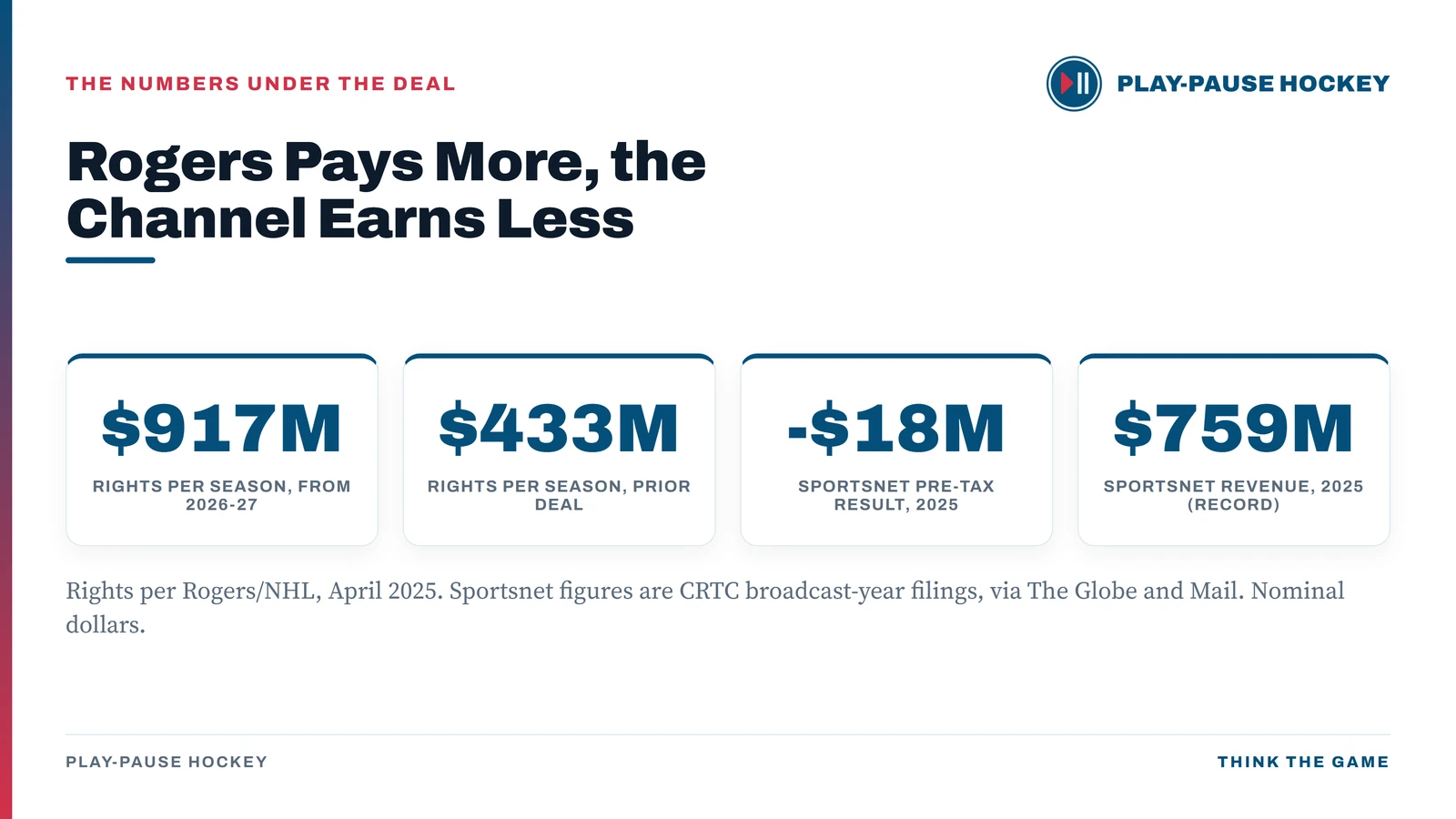
The numbers that explain the sale are in the CRTC broadcast-year filings, not the press release. The main Sportsnet service posted a $4.6-million pre-tax loss in 2024, its first on public record, then an $18-million loss in 2025, on record revenue of $759 million. Rising rights costs are the reason.
Sportsnet's CRTC financial results were reported by Simon Houpt of The Globe and Mail on July 28, 2026.
Now set that against the company. Rogers guided its sports and media segment to roughly $3.9 billion in pro forma revenue and $250 million in adjusted EBITDA for 2025.
It is also spending like it: 75 per cent of Maple Leaf Sports & Entertainment taken on July 1, 2025, and an agreement to buy Kilmer Sports’ remaining quarter for $4.35 billion, closing late in 2026 subject to league approvals.
So the pressure is specific. It sits on a linear channel whose rights bill went from $433 million a season to $917 million while its audience ages, not on a balance sheet. Last month Rogers announced it was pulling Saturday games off CBC, ending 74 years of Hockey Night in Canada there. A fourth weekly hockey night was the next thing that channel would have been asked to carry.
That reorganization is not only Canadian. The NHL’s regional broadcast collapse left four American clubs relying on NHL Productions, and local media rights there are being rebuilt on the same logic: move the audience to whoever already has it.
The Case for Rogers, and It Is Not a Weak One
The strongest objection is that 26 games is too small a hook to hang a thesis on. Sportsnet keeps most of the schedule, Rogers collects a fee instead of production costs, and more Canadians can reach a Wednesday game through Prime than through cable. Read that way, this is distribution, not withdrawal.
There is a viewer-facing gain too. The release promises “more national games and fewer blackouts to hockey fans,” and blackouts are what a Canadian fan actually curses at in October.
Concede the regular season entirely. It does not survive the playoff clause. A quarter of the first two rounds, every year until 2038, is not filler inventory. It is the hockey people rearrange their evenings for, and moving it is how a habit changes hands rather than a time slot.
The audience case is real too. Amazon’s Christopher Walton told a Toronto conference that average viewing time in its first NHL season was 73 minutes against Sportsnet’s 58 in the same Monday slot a year earlier, with a median viewer age of 43 against 55. Amazon’s own numbers, not independent measurement. They still point at the audience linear television has been losing.
Watch the Second Round, Not the Wednesdays
Amazon has run this sequence before: one exclusive weekly package in the NFL from 2023, one in the NBA from 2025-26, then more. In Canada it took Mondays in 2024-25 and now holds Wednesdays and playoff hockey.
October’s Wednesday ratings will not tell you much. Watch the second-round series next spring, the first time a Canadian fan will have no choice but to open Prime for a playoff game that matters. If it holds its audience, the 2038 version of this deal will not be 26 games.