

Sports Business Journal put a number on the NHL’s rescue of four broadcast markets this week: a high-seven to low-eight-figure sum, spread over three seasons. Do the division the league did not do for you. Four clubs, three years, twelve club-seasons. Read SBJ’s range at its low end and the league is spending about $600,000 per team per year. Read it at its most generous and it is still under $1.7 million. That is the price of keeping Carolina, Columbus, Minnesota and St. Louis on television at all.
Against a $104 million cap, even the expensive reading comes to under two percent of a single club’s payroll. The league is spending less to rescue an entire market’s local broadcast than that club spends on its fourth line.
Then there is the part the money did not buy. Ten weeks from opening night, three of these four clubs still cannot tell a fan which channel to turn on. And the four are not even in the same situation, which is the thing every version of this story got wrong.
The Number Tells You Exactly How Big This Fix Is Meant to Be
Per Awful Announcing and Barrett Media, both citing Sports Business Journal, July 21, 2026. The per-club figures are ours, derived from SBJ's range. SBJ published the range, not exact endpoints, so treat the bounds as bounds.
Nobody at the league is pretending otherwise, which is to their credit. NHL Productions is supplying crews, graphics and replay technology. It is a truck, a control room and a staff. Steve Mayer, the league’s President of Events and Content, framed it as capability rather than rescue: “Adding live production capabilities is a natural next step, allowing us to introduce groundbreaking technologies, innovative graphics and bold creative concepts.”
The reason it sounds smaller than the headlines is that it is smaller than the headlines. “NHL takes over TV production” reads like the league became a broadcaster. It became a vendor.
Put the figure next to a player and it stops being abstract. James van Riemsdyk played the 2025-26 season on a $1 million cap hit, put up 31 points, and is one of the veterans still waiting out the 2026 aging-winger market. Whatever the league is spending to keep Columbus on the air next season lands in that same bracket. One depth forward.
Ten Weeks to Opening Night and Three Clubs Have Nowhere to Put the Games
Here is what the announcement did not include: a channel.
Producing a telecast and distributing one are different businesses, and only the first has been solved. As of July 21, Columbus, Minnesota and St. Louis had not announced a carrier, a streaming service, a channel position or a price. Carolina raises its second championship banner on September 29 against Florida. Columbus opens October 1 against Buffalo. A fan in Ohio who wants to watch that game today cannot be told how.
This is the wreckage of a collapse that has been coming for years. Main Street Sports Group, the company that emerged from Diamond Sports Group’s bankruptcy and rebranded its channels as FanDuel Sports Network, announced in April that it would wind down operations, taking fifteen regional channels with it. Forbes had counted ten NHL clubs whose local broadcasts were at risk back on January 31, when Main Street was already missing rights payments and asking teams to accept fee reductions and deferrals.
Some clubs got out on their own terms. Nashville signed a multi-year deal with Scripps on April 7 and moved to free over-the-air television on WNPX. The Ilitch group launched Detroit SportsNet in March as the year-round home of the Red Wings and Tigers. Baseball’s Los Angeles Angels bought out Main Street’s stake in FanDuel Sports Network West outright and relaunched it as Angels Broadcast Television, which keeps the Kings on the same channel position they already had. Four clubs had no such exit.
The league’s own read on the situation came from David Proper, its Chief Media Officer, who told ESPN: “It’s a crazy time in the media space. I mean, there’s just no getting around it.” That is not a man describing a finished plan.
Carolina Is Not Doing What Columbus Is Doing
Start with what these clubs actually signed, because they did not sign the same document. This is the difference that decides who comes out of 2026-27 in good shape.
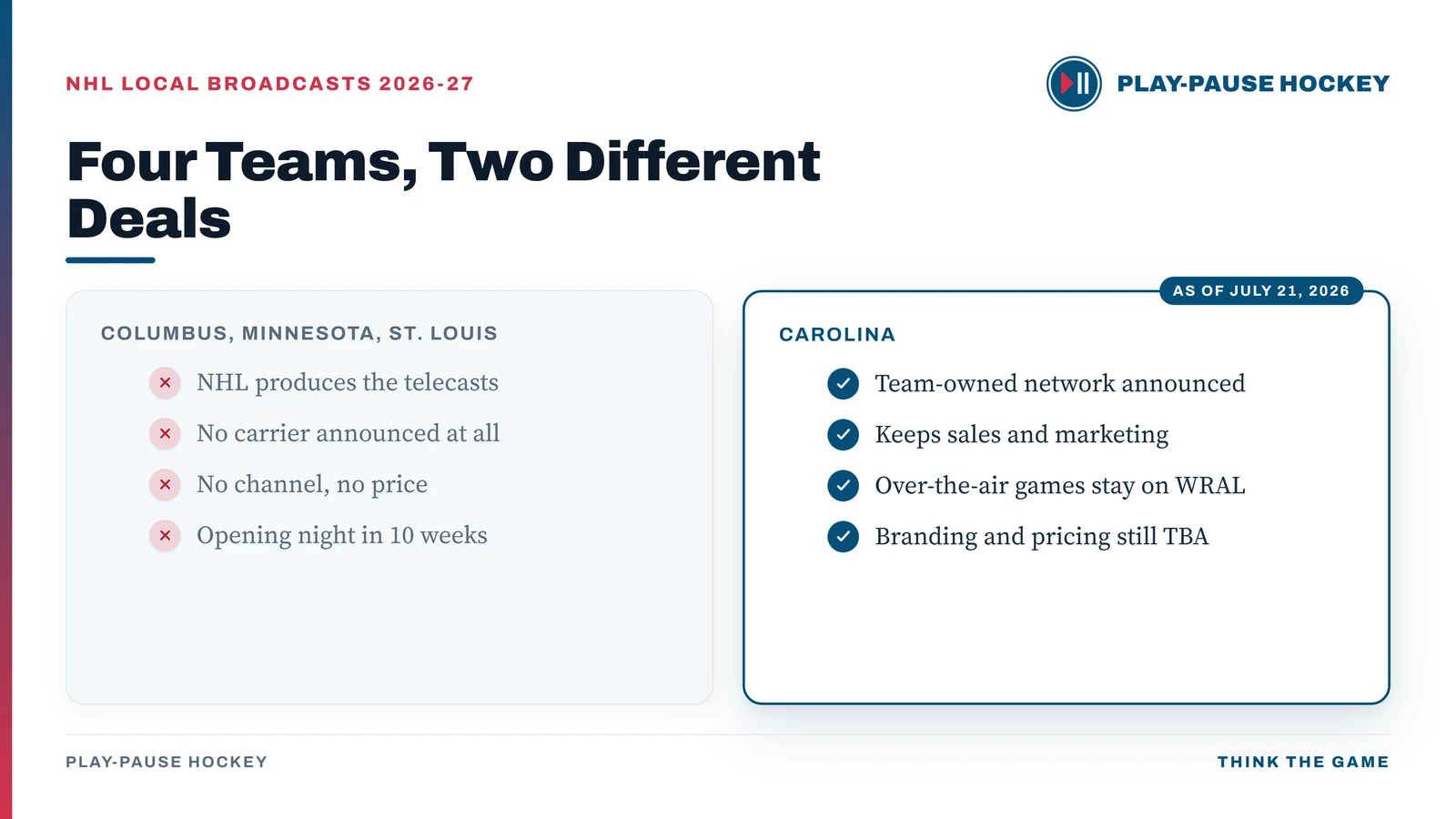
Carolina is not a client of the league in any meaningful sense. Hurricanes Holdings is building its own network and will own the production, the distribution, the ad sales and the marketing. The NHL supplies the cameras underneath it. Mike Maniscalco and Tripp Tracy return on the call, and the over-the-air simulcasts stay on WRAL. What is missing is the branding, the carriage and the pricing, all of it targeted for some point before September 29.
Columbus is buying a service. Marc Gregory, the club’s VP of Business Intelligence and Broadcasting, described it as leveraging “the league’s industry-leading production resources and storytelling capabilities.” True, and also the language of a team that has outsourced a function rather than acquired a business.
The distinction matters because of where the money is. Keith Wachtel, the NHL’s President of Business, said the quiet part plainly:
“When you control all of the different aspects of the production and the sales, what you have the ability to do, market, promote and sell, becomes infinitely better.”
He is right. He is also describing what Carolina just did and what the other three did not. Ownership of the stack is where the upside lives, and one of these four clubs went and got it.
Carolina did not invent this, either. Detroit ran the same play in March: Ilitch launched its own network and handed the production work to MLB Media, keeping the channel and the revenue in the family while renting the truck. Own the business, outsource the cameras. That is now a pattern with two data points and a Stanley Cup champion attached to the second one.
Yes, This Is Cap Money. No, Anyone Telling You How Much Is Guessing.
The sharpest objection to all of this comes from the cap side, and it deserves a straight answer rather than a dodge.
Local media revenue is hockey-related revenue. Hockey-related revenue is split fifty-fifty with the players and it is what sets the ceiling. If four clubs go from a regional rights fee to no announced revenue at all, the argument runs, that flows into the pool, and the rising salary cap everyone has been spending against gets a lot less comfortable in a hurry.
The mechanism is real. The number is not available. No outlet has quantified what the FanDuel Sports Network collapse costs the HRR pool, and neither can we, because the replacement deals in three of these four markets do not exist yet to be counted. Anyone who hands you a cap impact figure this week has invented it.
The 2026-27 Ceiling Is Already Safe. The Out-Years Are Not.
What can be said is narrower and more useful. The $104 million cap for 2026-27 is already set and will not move. The exposure sits in the out-years, and it is exactly why the league moved in July rather than in September. Proper’s framing of the whole exercise was revenue defense, not charity: “This new model strengthens the value of regional media rights by expanding the pool of potential distribution partners, reducing dependence on outside production providers and allowing Clubs to manage production investments more effectively.” The league is not replacing the rights fee. It is trying to make these four markets sellable again before somebody has to explain a flat cap.
What Has to Land Before September 29
Watch for three announcements, in this order of significance.
A distributor for Columbus, Minnesota or St. Louis is the one that matters. Production without carriage is a rehearsal. The moment one of the three names a partner, the price it accepts becomes the market rate every remaining club gets measured against.
Carolina’s network name and pricing come next, and specifically whether it goes direct-to-consumer, because a Stanley Cup champion is the strongest possible test case for whether a team can out-earn its old cable fee by selling straight to its own fans.
Then Anaheim and Dallas. Their streaming partner, Victory+, has missed rights payments per ESPN, which makes them the obvious candidates to join this arrangement and turn a four-team accommodation into something the league has to admit is a system.
A league with an 84-game schedule has more inventory to sell than it has ever had. Right now it cannot tell fans in three of its markets where to find any of it. The truck arriving is not the story. The channel is, and the channel is still missing.