

The last time Jamie Drysdale played a full NHL season, the two that followed went mostly to injury. Philadelphia just bet $26 million it will not happen a third time.
The four-year contract Drysdale signed on July 17 carries a $6.5M cap hit, and on talent alone that number holds up. He is a 24-year-old right-shot defenceman who moves the puck as well as anyone his age, coming off career highs, now installed as the cornerstone of the Flyers’ long-term blue line. Right-shot defencemen who skate and pass like he does do not come cheap. At $6.5M, he is Philadelphia’s highest-paid defenceman, a notch above Travis Sanheim’s $6.25M, and that is not an overpay for the player.
The dollars were never the question. The term is. The Flyers are paying top-pair money on the evidence of one healthy year, and they are guaranteeing four more to the one thing about Drysdale that has never held up: his availability.
Why the Flyers Settled Before the Hearing
Drysdale had a salary-arbitration hearing booked for July 20, the first date on the entire league’s board. Settling three days early took it off the table.
The timing tells you where this front office is. Two days earlier the Flyers had committed four years and $36.5M to Trevor Zegras, the other July 5 arbitration filer, days after Anaheim matched their $18M offer sheet on Leo Carlsson. Drysdale is the third piece of that same aggressive week, and the one Philadelphia clearly wanted locked before an arbitrator handed him a one-year number and a faster path to unrestricted free agency. Sign the term now, keep the player through his prime, and take the injury risk onto the books yourself.
Two Full Seasons in Six Years
Here is the record the Flyers just bet against.
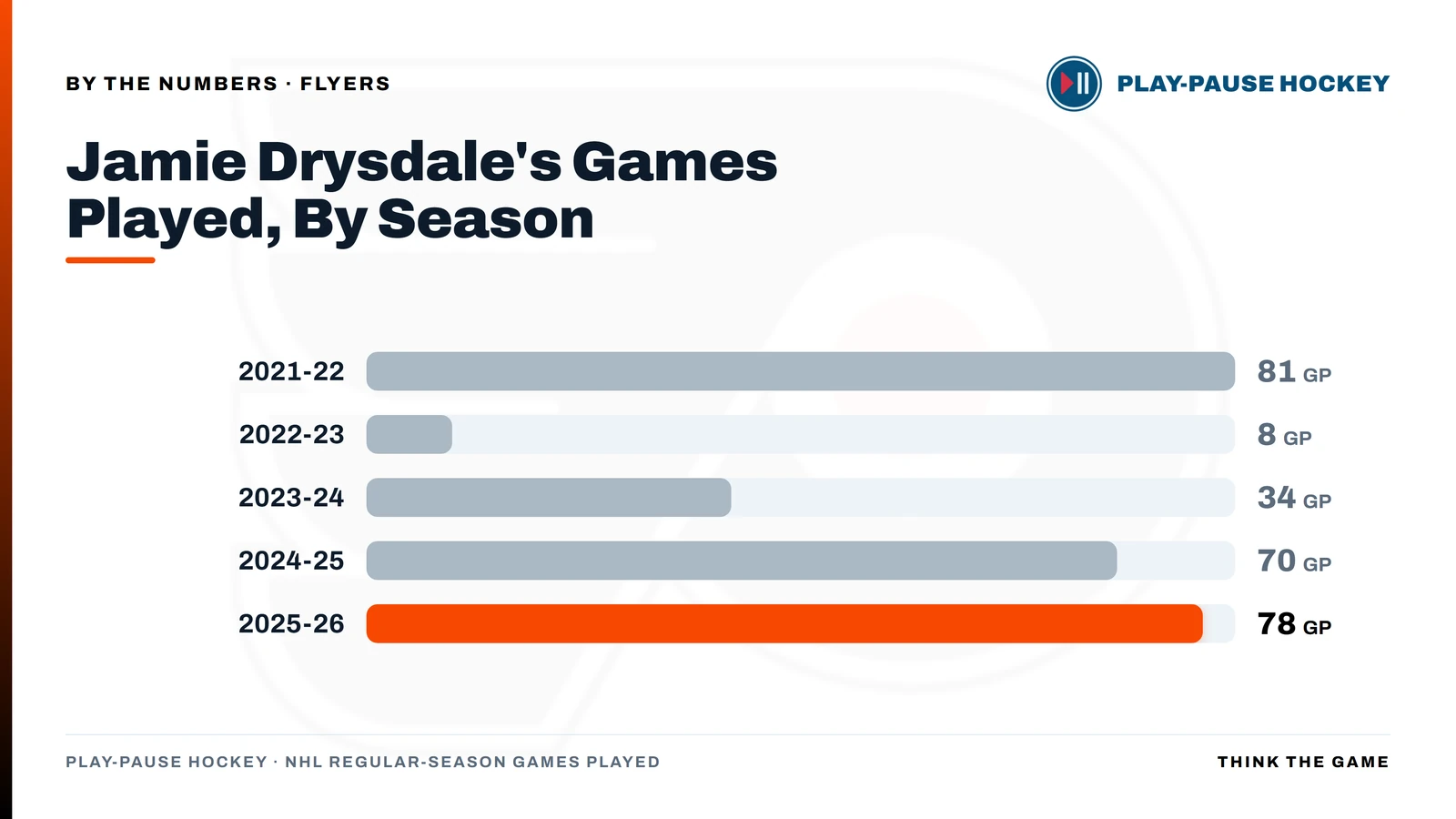
The shape is hard to miss. Drysdale played 81 games in 2021-22, then a torn labrum in his left shoulder wiped out all but eight of the next year. In 2023-24 he dressed 34 times across two teams, arriving in Philadelphia that January in the Cutter Gauthier trade, then losing 16 more games to an upper-body injury once he got there. He built back to 70 games, then a career-high 78. Progress, clearly. But the floor underneath it is the reason this deal is a gamble rather than a formality.
The market read that record the same way. Two comparable young defencemen signed this summer, Simon Nemec at five years and $7.25M and Pavel Mintyukov at five years and $7.2M, and both got more term at a higher annual number than Drysdale did. His deal is a year shorter and cheaper. That gap is not a verdict on his talent, which every scout rates higher than either of theirs. It is the price of a games-played column nobody can pencil in.
Why the Bet Might Still Pay
The counter-case is real, and Philadelphia is not wrong to make it. Drysdale is 24. His worst injuries were traumatic rather than chronic, a labrum tear and a pair of hard collisions, not a soft tissue that keeps failing on its own. He does not turn unrestricted until 28, so the term buys prime years, not decline ones. And the trend genuinely points up: 70 games, then 78, with a career high in goals, a points total that matched his personal best, and the heaviest workload of his career at 21:33 a night. If that version is the real one, $6.5M for a top-pair right shot is a steal, and the Flyers were smart to lock it in before the number climbed with the market.
That is the honest bull case. It rests entirely on one season being the rule instead of the exception.
The Only Number That Decides This Deal
For four years, forget the points and the expected-goals share. The stat that determines whether this contract is a bargain or an anchor is the plainest one on his card: games played. Drysdale does not have to become a Norris candidate to justify $6.5M. He only has to be on the ice, something he has managed for a full slate exactly twice in six years. Philadelphia just bet four more that the healthiest season of his career was the start of a pattern, not a break in one. The talent was never the risk here. The next 82 games are.