

The Contract Is Fair. The Timing Is the Tell.
Trevor Zegras is now the highest-paid player on the Philadelphia Flyers, and that is the least interesting thing about his new contract. Four years, $36.5 million, a $9.125 million cap hit, announced Wednesday and filed away by most of the league as a tidy piece of housekeeping before a July 22 arbitration hearing nobody wanted.
It is tidy. It is also fair, which is the part that should stop you. Set $9.125 million against the $18 million Philadelphia offered Leo Carlsson twelve days earlier and the Flyers look like a team that detonated the restricted free agent market and then walked away from the blast without a scratch.
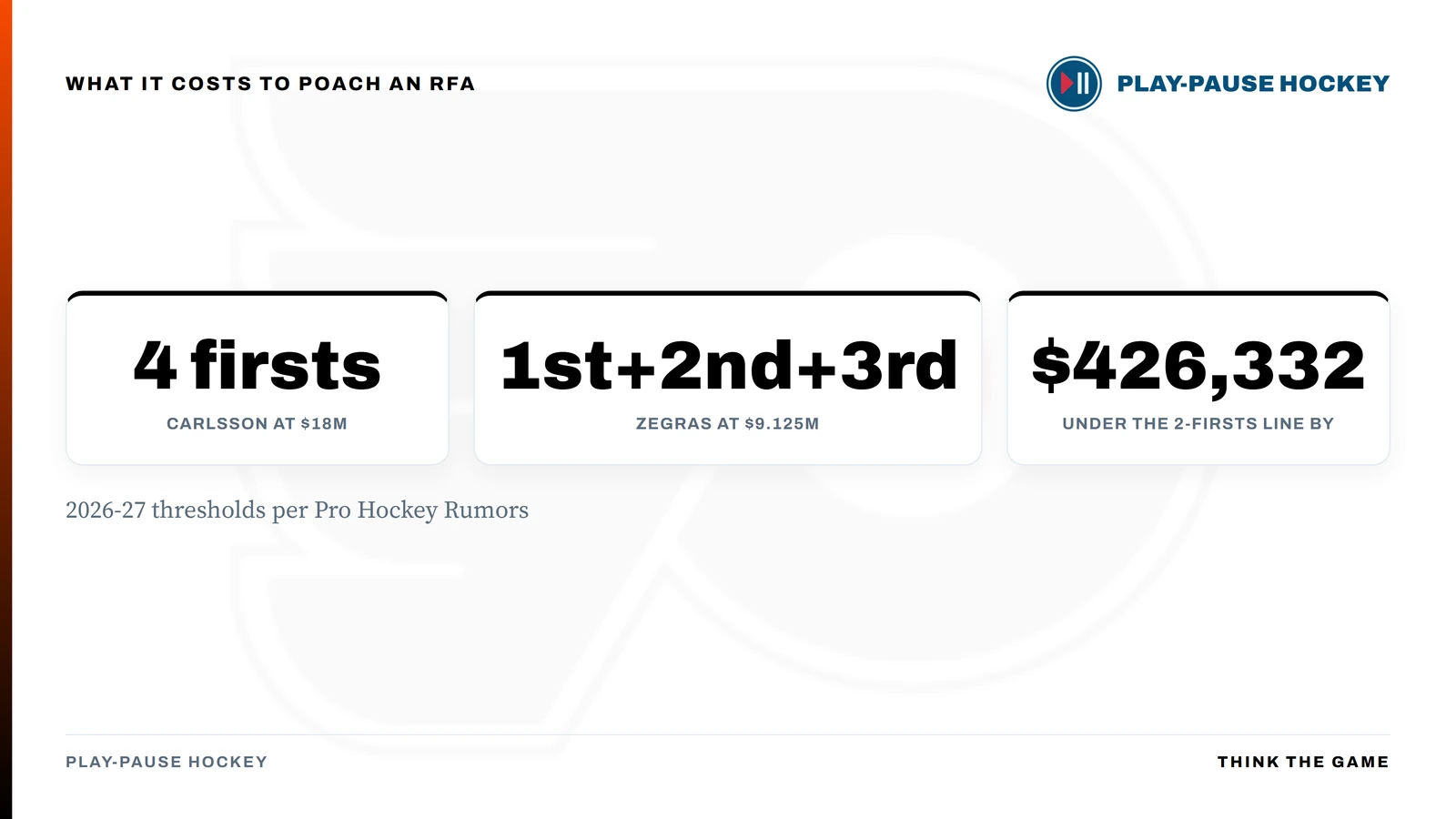
They did not. Here is what the recaps skipped: at $9.125 million, Zegras sits $426,332 under the line where tendering him would have cost a rival two first-round picks instead of one. Philadelphia had just offered four for Carlsson. For two days in early July, the team that had fired the highest-AAV offer sheet in NHL history was carrying the cheapest target on the board, and the thing that closed the window was not a Danny Briere masterstroke. It was Zegras filing a piece of paperwork against his own club.
Philadelphia Spent Two Days Exposed to Its Own Weapon
Start with what the Flyers did on July 3, in their own words.
Read the last clause again, because the Flyers wrote the rulebook into their own announcement. Four first-round picks. That is the price of the top compensation tier, and Philadelphia volunteered to pay it in public, on a 21-year-old center who had never signed a second contract.
Anaheim matched on July 9 and the picks stayed home. But an offer sheet is not a free swing, and the cost was never really the picks. It was the precedent. A front office that publicly declares four firsts an acceptable price has told all 31 rivals exactly how it values young centers, and it has done so while its own 25-year-old center sat unsigned. Retaliation in this league is not a theory. It is a phone call.
Two days after the Carlsson offer sheet, on July 5, Zegras filed for salary arbitration. So did Jamie Drysdale, the Flyers’ 24-year-old defenseman, on the same day. The Inquirer’s Jackie Spiegel drew the line that evening, hours after the filings landed: “With the filing, the two players are no longer eligible to be tendered an offer sheet.”
Two of Philadelphia’s unsigned restricted free agents, both off the board within 48 hours of their employer making the loudest offer-sheet play in a generation. Read that as coincidence if you like.
What It Would Have Cost to Come After Trevor Zegras
This is where the math gets uncomfortable for Philadelphia.
Take Kaplan’s number and run it through the 2026-27 compensation table the NHL set in May. An offer sheet between $7,163,498 and $9,551,332 costs the poaching club a first, a second and a third-round pick. Above $9,551,332, the price jumps to two firsts, a second and a third. Zegras signed at $9,125,000.
Offer-sheet thresholds for 2026-27 per Pro Hockey Rumors, May 20, 2026. The top tier, over $11,939,166, is the four-first-rounder bracket the Flyers cited in their own Carlsson announcement.
So price him honestly. A 25-year-old center coming off career highs of 26 goals and 67 points in 81 games, shooting 15.6%, with 23 power-play points and 10 playoff games behind him. On the open market that player is worth a first, a second and a third. Philadelphia had just told the league it would surrender four firsts for a younger version of him.
That asymmetry is the whole story of the Flyers’ July. Not that they overpaid Zegras. That they made themselves the most obvious retaliation target in hockey while holding a roster asset priced in the bargain aisle of the compensation table.
We have watched a team play this line on purpose. The 2026 offer sheet summer produced a clinic eight days ago, when New Jersey set Barrett Hayton’s cap hit at $4,775,000, exactly $666 below the point where offer sheet compensation jumps a full tier. That was engineering. Zegras is the opposite. Nobody designed his $426,332 of clearance and nobody in Philadelphia wanted it. The Devils used the line as a weapon. The Flyers simply woke up on the wrong side of one.
Per the NHLPA, 15 restricted free agents elected salary arbitration on July 5, 2026, Zegras and Drysdale among them. Hearing dates run July 20 to August 1, with Drysdale drawing the first slot on the board and Zegras July 22, per Pro Hockey Rumors.
Philadelphia Would Have Just Matched
The Offer Sheet Is a Pen, Not an Abduction
Here is the objection that actually lands, and it is the first thing any cap watcher types: the Flyers had roughly $20 million in space. A rival tenders Zegras at $9.5 million, Philadelphia matches before lunch, the picks never change hands, and the compensation tier is trivia. If he was never realistically leaving, he was never really stealable.
That is correct, and it forces the point to be sharper than theft.
An offer sheet in 2026 is not an abduction. It is a pen. A rival does not need to want Zegras in its own sweater; it needs Philadelphia to own him on a structure Philadelphia did not choose. Front-load the signing bonuses so the money lands in the wrong year. Set the term so he hits unrestricted free agency at the worst possible moment. Utah lived exactly this eight days ago: it matched New Jersey’s offer sheet on Barrett Hayton and inherited a one-year deal it cannot trade out of for a calendar year, with Hayton walking to unrestricted free agency on July 1, 2027. Utah kept its player and still lost the negotiation.
Matching is not winning. It is paying someone else’s price to keep your own player.
So the exposure was never that Philadelphia loses Zegras. It is that Philadelphia keeps him on terms drawn in another team’s front office, at a compensation price low enough that a rival could afford to try. That is what the July 5 filing shut off.
Fifteen Players Filed That Same Day
The lesser objection is the base rate. Fifteen players filed that day. Jason Robertson filed. Cole Perfetti filed. Kirby Dach filed. Filing is the most routine thing an unsigned RFA does in the first week of July, and reading intent into two Flyers doing it is a narrative that dies the moment you check the denominator.
Fair. Two responses.
The first is mechanical. An RFA who elects arbitration comes off the offer-sheet board, which is why the filing does defensive work whether or not anyone intended it to. Daily Faceoff put it flatly on filing day: the players who filed “are no longer eligible to receive offer sheets from clubs who currently do not own their rights.” One wrinkle, flagged honestly rather than smoothed over: Sound of Hockey’s CBA explainer reads the block as landing at the arbitrator’s decision rather than at the filing, a narrower window. No source we found cites the governing article by number, and we are not going to invent one. The direction of the protection is not in dispute. Its exact start date is fuzzier than the confident recaps admit.
The second is situational. Robertson and Perfetti filed as leverage in stalled negotiations, and Perfetti’s five-year, $30 million deal on July 15 shows exactly how that script ends. Zegras filed 48 hours after his employer handed the entire league a public invoice for what young centers cost. Same action, different weather.
And the tell is Drysdale. A player filing for leverage does not need his teammate doing it in the same 48 hours. A team that has just made itself a target does.
Drysdale’s Hearing Is the Next Test
The verdict on the contract itself is straightforward: this is good business. $9.125 million is 8.8% of the $104 million upper limit, for a center entering his prime who just posted the best season of his career. Briere kept him a stride ahead of Konecny’s $8.75 million, bought two years of unrestricted free agency, and gave up only a limited no-trade clause in years three and four. On value, Philadelphia won.
On sequencing, they got lucky. The Carlsson bid was a swing at a franchise center and it missed, and for two days in early July it left the Flyers holding a 67-point center priced below the two-firsts line while all 31 rivals held a fresh receipt for how Philadelphia values that exact player. Nobody pulled the trigger. That is not the same as nobody noticing.
Watch Drysdale, and watch him Monday. His hearing is July 20, the first slot on the league’s entire arbitration board, four days from now. Philadelphia has roughly $20 million in space, per Pro Hockey Rumors, and no particular reason to fight a 24-year-old defenseman it just spent a summer protecting. If that deal lands quietly before Monday, the Flyers close the summer having survived their own gambit intact. If it goes to a room, we learn something about how much of July was strategy and how much was a front office improvising after it swung first.