

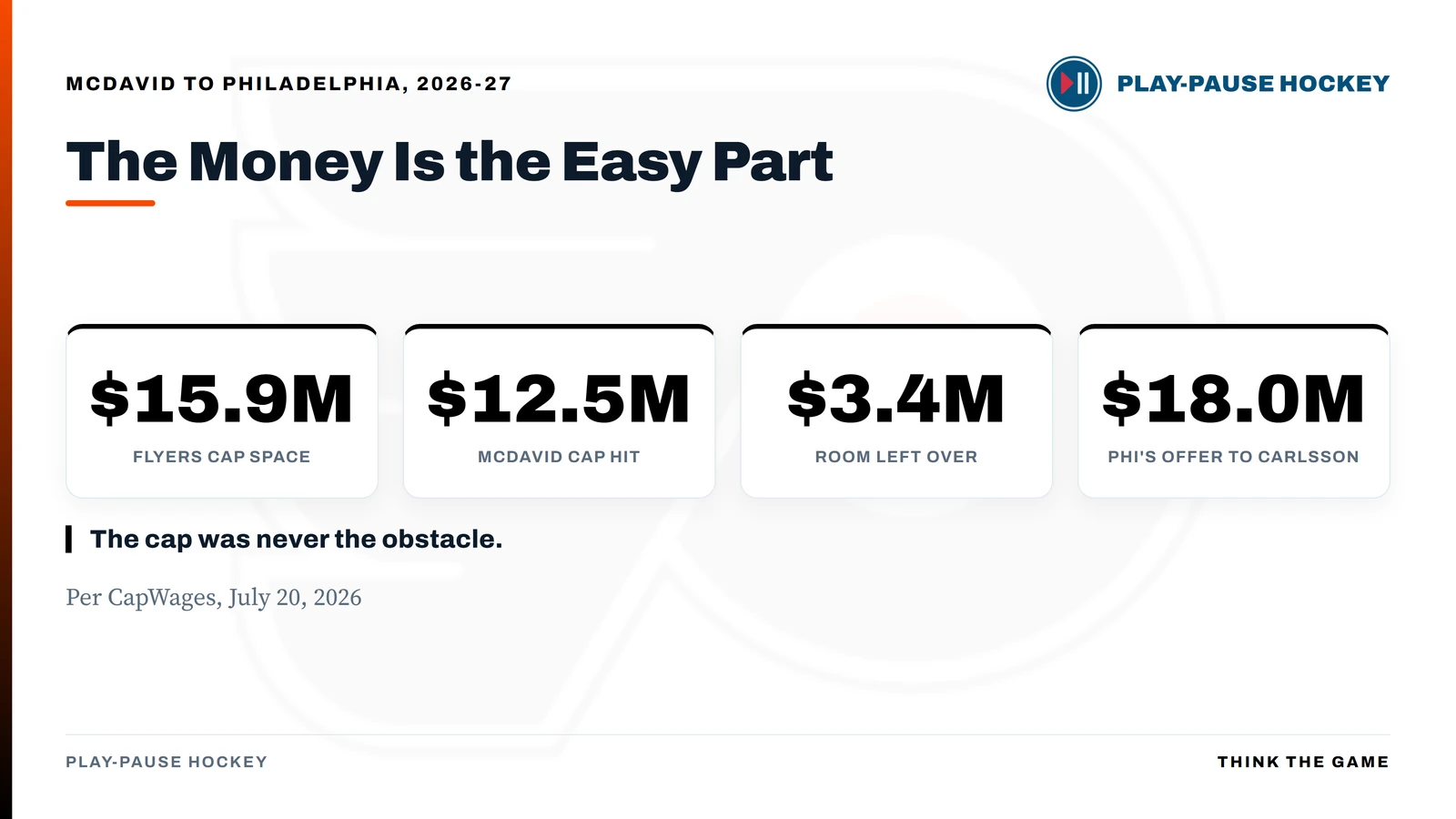
Start with the part nobody bothered to check, because it is the part that makes this whole thing feel possible. Philadelphia has about $15.9 million in cap space for 2026-27. Connor McDavid costs $12.5 million against the ceiling. The money works. There is even change left over.
That is where it stops working.
Over the weekend a Philadelphia radio segment became a national story, and by Monday the best player alive was being discussed as a Flyer by people who should know better. The rumor is not true. Every outlet that bothered to check has said so.
What none of them checked is the money, and that is the part worth your time: the cap sheet cooperates completely, the rulebook does not, and the gap between those two facts is the whole reason a throwaway radio hit traveled this far. Understanding which half is real is the difference between reading hockey and repeating it.
The Money Fits. That Is Where the Fantasy Stops.
Philadelphia sits at roughly $88.1 million in committed cap hits against a $104 million ceiling, per CapWages as of July 20, leaving $15,874,999 in room with 21 of 23 roster spots filled. Fill those last two spots at something near the league minimum and the Flyers still clear McDavid’s $12.5 million.
Sit with that number, because it is the quiet scandal of the McDavid contract and the reason a rumor like this has any oxygen at all. The best player in hockey takes up twelve cents of every cap dollar, less than Leon Draisaitl costs on his own team. He is, in the most literal accounting sense, affordable.
None of them can have him, and the reasons have nothing to do with money.
Philadelphia Spent Three Weeks Making This Rumor Believable
A rumor needs a plausible home. Philadelphia spent three weeks building one.
On July 3, general manager Danny Briere tendered Anaheim restricted free agent Leo Carlsson a five-year, $90 million offer sheet, an $18 million AAV that was the richest in league history at the moment it was signed.
That figure was not an accident of negotiation. It was pushed deliberately past $11,939,166, the line above which an offer sheet triggers the NHL’s maximum compensation tier: four first-round picks, one in each of 2027, 2028, 2029 and 2030. Briere signed that paper knowing Anaheim might simply take the picks and walk. The Ducks matched on July 9 instead, so the Carlsson offer sheet ended up costing Philadelphia nothing. That is a result, not a plan. He was one ownership decision away from paying almost everything.
Then Briere signed forward Trevor Zegras to four years at $9.125 million on July 16, and locked up defenseman Jamie Drysdale for four years at $6.5 million on July 17, three days before a scheduled arbitration hearing. Taken alone, the Trevor Zegras contract and the Jamie Drysdale contract are sober, well-timed business. Taken together with the swing at Carlsson, inside three weeks, they draw a portrait of a general manager with an appetite.
Run the comparison the rumor mill never runs. Philadelphia’s offer to a 21-year-old with a fraction of McDavid’s résumé was 44 percent larger, per season, than what McDavid himself earns.
That is the real finding here. Fans did not invent a Flyers-McDavid link out of nothing. They watched a general manager spend three weeks demonstrating that he would pay any number for a young star, and then heard a familiar voice suggest the biggest star of all might be gettable. The premise was pre-approved. All the rumor had to do was arrive.
”Calling Teams” Has the Mechanism Backwards
The source is Todd Fedoruk, who played 545 NHL games as a forward and now works as a color commentator for 97.5 The Fanatic in Philadelphia. In a clip that circulated on July 16, he suggested that if McDavid stumbles out of the gate, “he is going to be a player who will be calling teams,” adding that “his agent is going to be looking for him to go places” and that “there are rumors that Philadelphia is a place that Connor McDavid wants to go.”
Fedoruk's comments were made on air at 97.5 The Fanatic and circulated the week of July 16, 2026. He is a former player working in radio, not a reporter, and as of this writing no insider has corroborated the claim.
NHL insider Jimmy Murphy needed one sentence.
Murphy is being funny about something structural. The scenario Fedoruk described, in which a signed player’s representatives go shopping around the league, is the specific activity the CBA’s anti-tampering provisions exist to prohibit. A club may not solicit or negotiate with a player under contract to another club without permission, and the league polices it actively enough to have issued a tampering memo this past May. Whatever conversation eventually decides where McDavid plays in 2028, it cannot be the one described on the radio, because that one is against the rules.
The contract closes the rest. McDavid signed a two-year, $25 million extension on October 6, 2025. It runs through 2027-28. It carries a full no-move clause in both seasons, per CapWages. He is not a free agent, he is not approaching free agency, and he cannot be moved anywhere he has not personally blessed.
The One Door That Is Actually Open
Here is the objection that deserves a real answer, and it is the first thing a cap-literate fan will type: a no-movement clause is not only a shield. A player who holds one can ask out, name his destination, and effectively steer his own trade. No tampering required, because the player initiates rather than the clubs.
That is correct, and it is the only genuine path this rumor has. It is also the path nobody can produce evidence for. A trade request from a player of McDavid’s stature does not stay quiet; it arrives through Friedman or LeBrun within hours, not through a Philadelphia drive-time segment. No insider has reported one. The Oilers have not behaved like a club managing one.
Conceding this actually sharpens the point rather than softening it. The only door into a McDavid trade is McDavid, which means the entire rumor reduces to a claim about his private intentions, sourced to a former player with no line into his camp.
Strip away the cap math and the destination talk, and what is left is a guess about one man’s state of mind, made on the radio, in a market that wants it to be true.
What honesty requires is admitting the door is not welded shut. Edmonton’s summer has not been reassuring. The Oilers fired Kris Knoblauch after a first-round exit to Anaheim and hired Mike Babcock on June 23, a move that generated real friction league-wide, and they open the season with Edmonton’s goaltending still unsettled. McDavid’s own two-year term, short by superstar standards, reads like a clock on the front office rather than a commitment to it. Anyone insisting his future in Edmonton is guaranteed is doing the same thing the rumor is doing, in the opposite direction.
What Would Have to Happen First
Before a McDavid market exists, three things have to be true, in order. He has to decide Edmonton has failed him, which is a 2027 question at the earliest given the term he signed. He has to make that known himself, publicly or through a request that leaks in minutes. And only then does anyone’s cap sheet matter.
Philadelphia’s does, for the record. That is the strange part. The Flyers would be a live participant in a market that does not exist, which is exactly the condition that turns a radio segment into a headline. Fans checked the money, found that it worked, and stopped checking.
Watch Edmonton’s start under Babcock, because Fedoruk’s one defensible instinct was the conditional at the front of his sentence. Everything after “if he doesn’t have a good start” was invention. The “if” is fair.