

Start with the number, because the number gives it away. New Jersey’s offer sheet to Barrett Hayton carries a cap hit of $4,775,000. The line where offer-sheet compensation jumps from a single second-round pick to a first and a third sits at $4,775,666. The Devils came in $666 under it.
That is the thing you will not get from the transaction wire, which files this as “Devils tender $4.78M offer sheet” and moves on. Round the figure and it looks routine. Read it to the dollar and it looks engineered. One more dollar of salary and New Jersey pays twice the freight to pry Hayton loose. They stopped one rounding error short, and that precision is the whole story.
New Jersey’s Offer Sheet Was Never Built to Sign Barrett Hayton
An offer sheet for a 26-year-old who scored 25 points last season is not, on its face, a headline. Hayton had 10 goals and 15 assists in 67 games for Utah in 2025-26 and has averaged around 16 minutes a night since 2021-22, per his career record. Useful. Not a player you burn draft capital over.
Which is the point. The Devils did not structure this to win Hayton. They structured it to hand Utah a bill it can’t pay cleanly, at the lowest price the rules allow. If Salt Lake City lets him walk, New Jersey adds a former fifth-overall pick for the cost of one second-rounder. If it matches, New Jersey walks away having forced a rival front office to spend, and having spent nothing itself. There is no version where the Devils lose the exchange badly.
Why Bill Armstrong Is Out of Good Answers by Wednesday
Utah general manager Bill Armstrong has until Wednesday, July 8, to exercise his right of first refusal, and both moves cost him.
Match the sheet and the cap hit is the easy part. The trap is in the term. A matched offer sheet locks Hayton in place for a full calendar year, no trades allowed, and then sends him to unrestricted free agency on July 1, 2027. Armstrong would be paying $4.775 million to rent a player he can neither move nor keep, on a roster that no longer has room for him down the middle. Utah traded for Vincent Trocheck and his $5.625 million cap hit this summer and brought back Kevin Stenlund, pushing Hayton from a top-nine center to a luxury the lineup doesn’t need.
Decline, and Armstrong hands a former top-five pick to a rival for a mid-round asset, the kind of return that gets a GM second-guessed for a year. Andy Strickland has reported Utah is expected to match. That is the humane read, and it is still a defeat: the club keeps a player it was ready to move, on terms New Jersey chose.
What $4,775,000 Buys the Devils That $4,775,666 Wouldn’t
The mechanism is worth slowing down on, because it is the part the “more complicated than you think” coverage circles without landing.
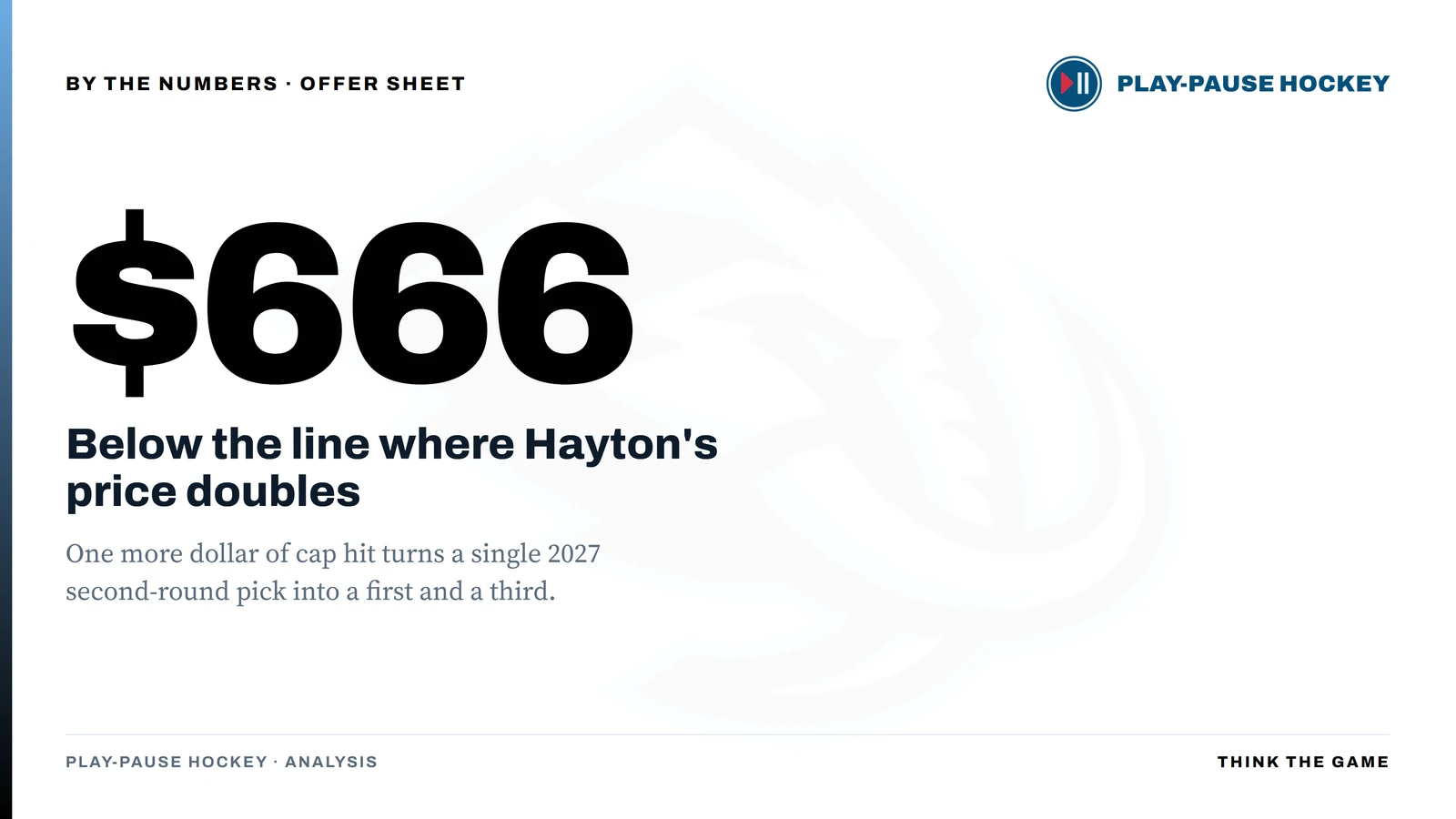
Offer-sheet compensation runs on brackets pegged to the average league salary, and this summer the second-round-pick tier tops out at $4,775,666. Everything from there up to roughly $7.16 million costs a first and a third. New Jersey set Hayton’s salary as high as it could go while staying in the cheap tier, then stopped. The high number is a raise big enough to make matching hurt. The stop, $666 short, is what keeps New Jersey’s own cost at a single pick. Maximum pressure on Utah, minimum price for the Devils. That is not a coincidence you back into.
Where the “Devils Genius” Read Falls Apart
Here is the honest counterweight, and it matters.
If Utah matches, as the reporting expects, New Jersey ends up with nothing. No player, no pick, and a tipped hand on a center it clearly likes. Reports have already floated fallback targets for the Devils if this fails, so the attempt cost them little. Little is not nothing. And from Utah’s side, $4.775 million for a matched Hayton isn’t a cap crisis; the club keeps a genuine NHL center cheap for a year, and a one-year rental that ends in free agency is a soft poison, not a fatal one. The word for what New Jersey did is not “steal.” It is “squeeze.” The Devils spent a week of leverage to make a rival slightly worse off and themselves no worse. Call it clever, not larcenous.
What Utah’s Decision Tells the Other 30 GMs
The lesson isn’t really about Hayton, and it isn’t really about Utah. It’s that the tool everyone declared dead is back, and the math is why.
This is the second offer sheet of the summer, after Philadelphia’s five-year, $90 million bid for Leo Carlsson that Anaheim has until July 10 to match. When the cap climbs faster than the talent pool, restricted free agents become the only underpriced assets left, and the compensation brackets climb with the cap, so the price of poaching one falls in real terms. That combination turns the offer sheet from a reckless overpay into a cheap, low-downside play. New Jersey just showed the league how to weaponize the fine print for the cost of a second-round pick. The next front office that runs the numbers on an RFA-rich rival will find the same $666 sitting there, waiting. Watch how many take it.