

A graphic went around X and Facebook this month with nine Calgary forwards laid out in their jerseys, one question stamped across the top: is this the worst offense in NHL history?
The history is wrong, and it is not close. The roster read underneath it is worse than the joke, and almost nobody is making it. Those nine names are not a cherry-picked worst case, not the injured list, not a gag. They are the depth chart.
The Worst Offense in NHL History? It Isn’t Close
Calgary scored 208 goals in 82 games last season, dead last in a 32-team league (ESPN team stats, 2025-26). That is 2.54 per night. It is genuinely bad and the Flames’ own beat writers spent the winter saying so.
Now put it next to the team the phrase “worst in NHL history” actually belongs to. The 1997-98 Tampa Bay Lightning scored 151 goals in the same 82 games. Calgary scored 38% more than that. And Tampa did it in a lower-scoring league than today’s: that season one player in the entire NHL reached 100 points, and the league set a record with 160 shutouts.
So the era adjustment runs against the meme, not for it. Today’s NHL scores more, and Calgary still cleared that bar by 57 goals. Last in the league is a real thing to be. Worst ever is a different address entirely.
That should be the end of it. It isn’t, because the graphic accidentally found something true.
Morgan Frost Is the First-Line Center, and That Is the Diagnosis
The instinct when you see a list like that is to assume somebody stacked the deck: pulled the injured guys, the fourth-liners, the AHL call-ups, and passed it off as the roster.
Check it. Per Daily Faceoff’s current projected lines for 2026-27, Calgary opens with Matvei Gridin, Morgan Frost and Matt Coronato on the first line, Connor Zary between Mikael Backlund and Joel Farabee on the second, and Jonathan Huberdeau, Ryan Strome and Yegor Sharangovich on the third. That is the graphic. All nine, in order.
Morgan Frost is the projected first-line center. He is a good hockey player who scored 22 goals last season, and if he were your third-line center you would feel fine about your team. He is not a third-line center here. That is the whole article in one sentence.
Nine Forwards, 289 Points, Nobody Past 45
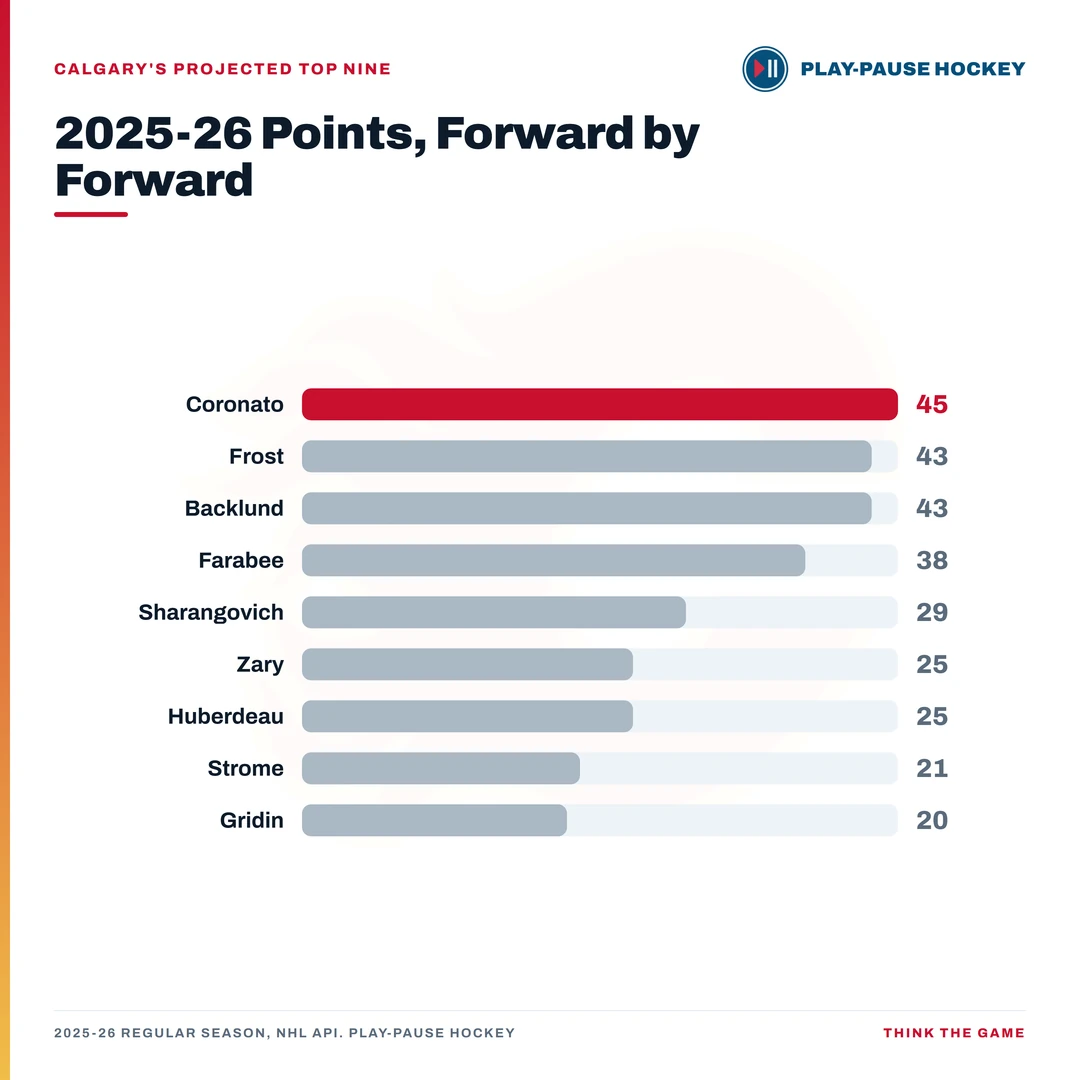
Look at the shape of it rather than the numbers. There is no spike. Coronato at 45, Frost and Backlund at 43, Farabee at 38, and then a slow drift down to 20. Nine forwards inside a 25-point band.
Bad teams usually have the opposite problem. They have one or two real players carrying a punishing load and nothing behind them, which is ugly to watch and relatively cheap to fix: you keep the star, you buy or draft the support. Calgary has inverted that. The Flames have a functioning middle six roughly three times over and no one to put on top of it.
Depth is usually tradeable. A first-line forward is not, at least not by anyone who has one. But that consolation is thinner here than the theory allows: Backlund is 37, Strome is 33, and Huberdeau’s contract makes him close to immovable. Calgary’s surplus is real, and most of it is not liquid.
It got this way partly on purpose. Nazem Kadri led the team in assists before Calgary moved him to Colorado at the March deadline for a package of picks and prospects.
That was a defensible trade for a team going nowhere, and general manager Craig Conroy has been open that it was the point. It also means the one forward on the roster who had ever been a genuine first-line contributor is now in Colorado, and the return was futures. The graphic is the residue of a decision, not an accident.
The Gridin Objection Is the Only Good One
Here is the pushback that actually lands, and it is not the cap.
Matvei Gridin is 20 years old. He put up 20 points in 37 games as a rookie last season after being drafted 28th overall in 2024. Give him a full season, healthy, in a real role, and he could be the first-line winger this whole piece says Calgary does not have. His coach believes it. Speaking on Sportsnet 960 in April, Ryan Huska said Gridin looked him in the eye and told him he would lead the team in scoring next year, with a straight face (The Win Column, April 25, 2026).
That objection deserves a real answer rather than a shrug, so here is the arithmetic. Gridin’s rookie rate was 0.54 points per game. Over 82 games that is 44 points. It would not have led this group last season. Coronato’s 45 did.
Rookies leap, and a straight-line projection undersells a 20-year-old with a summer of pro training in him. Fine. But notice the size of the leap being asked for. Gridin does not need to improve; he needs to add better than half again to his scoring rate, from a 44-point pace into the 70s, before Calgary has the player this article says it lacks. That happens. It happens rarely, and it is a strange thing to build a season on.
The cap is the reason there is no plan B.
Conroy said in May that free agency is not really going to be a thing for Calgary in the next few years, and that the team is really going to have to draft and develop. Read that next to the depth chart and it stops sounding like patience and starts sounding like arithmetic. It also lands in the wrong summer for it. The one mechanism that moved young top-end forwards this July was the offer sheet, and offer sheets require exactly the cap room Huberdeau is standing on.
Calgary is not one trade away. Calgary is one player away, and that is the harder number.
What Calgary’s Season Actually Rides On
The Flames finished 34-39-9 for 77 points last season. Nothing about the summer suggests a different number is coming, and the honest version of the Pacific race has Calgary watching it.
So watch the thing that decides whether this is a two-year problem or a five-year one. Not the standings, and not the goal total. Watch Gridin’s ice time in October and November, and whether Huska trusts him on the power play when the team is losing. A rebuild that is waiting on a 20-year-old has to actually play the 20-year-old.
The meme was wrong about history. It was right that something is broken, and it picked the wrong thing. Calgary’s problem is not that nine forwards are bad. It is that all nine are roughly the same, and the league does not hand out points for symmetry.