

Six teams. Five weeks. Zero trades. That is not what a bidding war looks like, and the reason is not the number Alexander Nikishin’s camp is asking for. It is the $4.82 million Carolina reportedly wants the buyer to carry out the door with him. Every outlet covering this story has reported that a market exists. What none of them has done is add up what a team in that market is actually being invoiced for, and once you do, the silence since early July stops being a mystery.
Carolina Isn’t Selling a Defenseman. It’s Selling $4.82M.
The public version of this story is straightforward. Nikishin, 24, finished his first full NHL season with 33 points in 81 games and a plus-18, won a Stanley Cup, and hit restricted free agency with leverage. Teams called. Carolina listened.
The version that explains the last four weeks came out on July 2, when David Pagnotta said on the Daily Faceoff Rundown that Carolina had attached a condition: you want Nikishin, you take Jesperi Kotkaniemi with him. Carolina has never confirmed that publicly. Treat it as a report, not a fact, and it still changes how the market reads, because it is the only available explanation for why a defenseman this many teams want has not moved.
Why a Six-Team Market Has Produced Zero Trades
The six-team number is real and it is sourced. It is also five weeks old.
Read that carefully. Dreger says the ask is a major factor. He does not say $8 million, and neither does anyone else on the record. That figure has circulated widely enough to feel established, and it is worth being blunt: it is a market expectation, not a reported term. Our read does not need it, which is the point.
The standoff has a cost that shows up in a list. Jeremy Rutherford of The Athletic noted in a late-July mailbag that Nikishin is one of only about ten restricted free agents league-wide still without a deal for 2026-27, nearly a month into free agency. Players in demand do not usually spend July there.
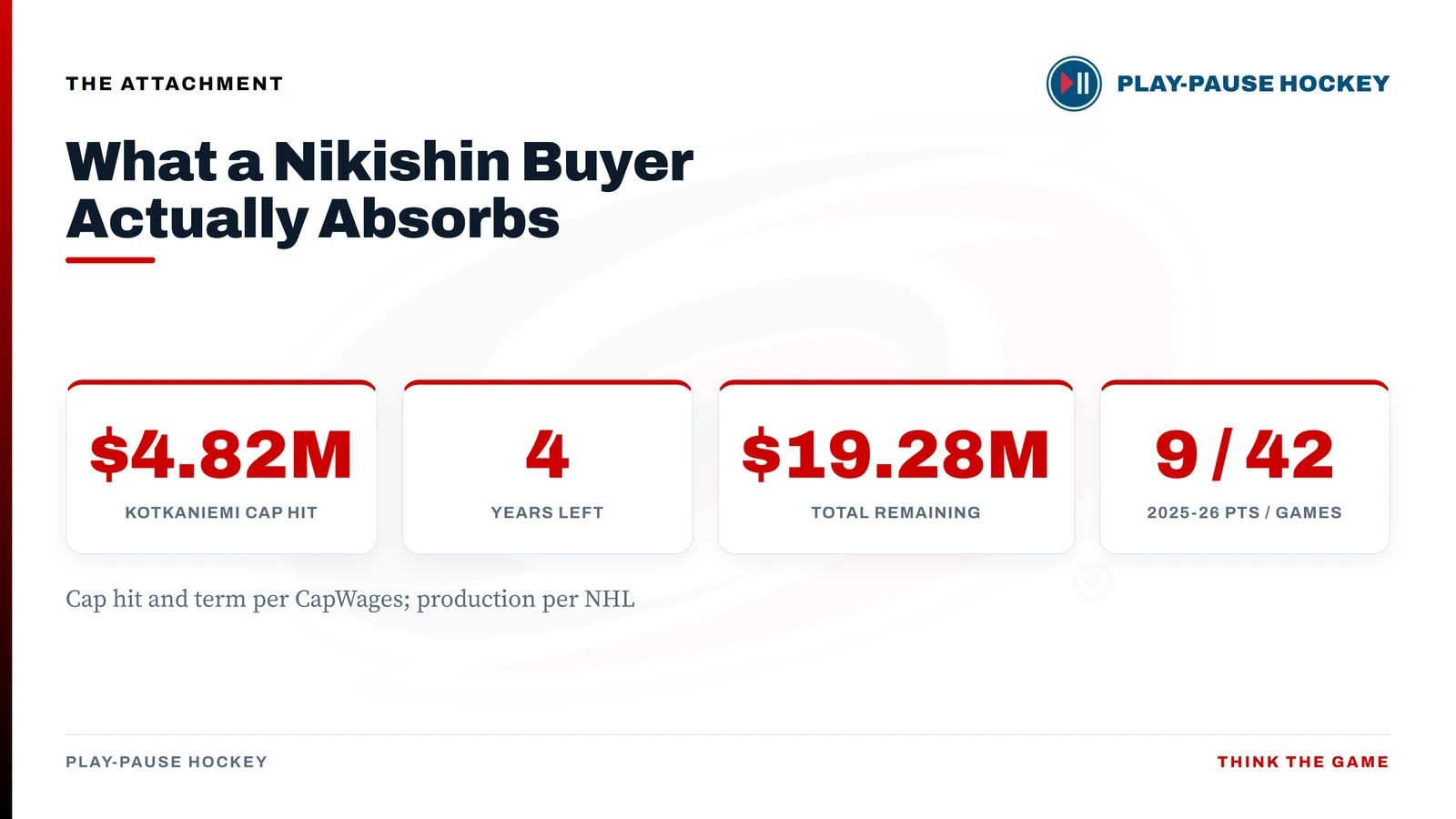
What a buyer knows for certain is the other half of the package. Kotkaniemi is 26 and put up 9 points in 42 games last season. His career line is 203 points in 518 games. He is signed through 2029-30 at $4.82M, per CapWages, on the eight-year deal Carolina handed him in March 2022 after the Montreal offer-sheet saga. Four seasons remain. That is where the $19.28M comes from, and it is our arithmetic, not a quoted figure: four years times a $4.82M cap hit.
The Cap Math That Decides Who Can Actually Bid
This is why the suitor list is shorter than six.
Start with the team that pushed hardest. New York was reported in late June to have made an aggressive run at Nikishin, and in June the Rangers had the room to back it: something close to $27 million in projected space. They spent it. CapWages now has New York at $2,260,208 with 22 of 23 roster spots filled against a $104 million cap. Whatever the Rangers wanted six weeks ago, they cannot absorb Nikishin’s new number today, never mind Kotkaniemi’s on top of it.
That leaves Vancouver, tracked somewhere between $18M and $22M, the most room the Canucks have had in the cap era. It is the one suitor that can pay Nikishin whatever he settles at and swallow Kotkaniemi without restructuring a thing. Even there the money is not free: Vancouver’s payroll order, the reported ownership mandate to cut as much as $20M, points the other way.
St. Louis is the control group. Rutherford reported in that same mailbag that the Blues remain interested but will not move Robert Thomas, and their space is tracked in the $4.4M range. Nikishin’s qualifying offer is a fraction of that, but nobody trades for a 24-year-old top-four defenseman to pay him a qualifying offer. Any market-rate deal clears $4.4M by itself, and Nikishin plus Kotkaniemi is not a negotiation, it is arithmetic they cannot solve. A team can want a player very much and still be structurally disqualified from bidding, and that is a different story than “the price is too high.”
Sort the six by whether they can absorb a second contract at all and the market does not thin, it nearly empties. That is not a bidding war. That is a shortlist Carolina built, and it may be one name long.
The Case That This Is Really About Nikishin’s Price
Here is the objection that deserves a real answer, and it is a good one: Kotkaniemi has a modified no-trade clause that kicked in for 2025-26, per CapWages. Carolina cannot send him wherever it likes. So how can the condition be the story if the player attached to it holds a veto?
That objection is correct, and conceding it sharpens the thesis rather than breaking it. A modified no-trade clause is precisely why this is structured as a condition rather than a completed salary dump. Carolina cannot dictate a destination, so it has to make the destination want him, and the lever it has is a 24-year-old defenseman other teams already want. The clause does not weaken the read. It explains the mechanism.
A veto doesn’t break the plan. It is the reason the plan needs a volunteer.
The narrower objection is fair too. Dreger named the contract ask, not the attachment, and it is entirely possible both are true: an unconfirmed eight-figure ask on a player with one NHL season, sitting on top of a cap dump nobody wants. Nikishin’s camp is asking for a number that only makes sense after the defenseman market reset, and 33 points is a thin sample to price against Cale Makar. A buyer paying that number wants term to go with it, the way the Marino extension bought Utah eight years of cost certainty on defense. Term is exactly what the calendar is about to take away. If the ask alone were the blocker, though, Vancouver would have closed the gap by now. It has the room, it has had it all summer, and it has not closed it.
What Has to Break Before September 16
Something in this has to give, and the calendar is now part of it. The new collective bargaining agreement takes full effect on September 16 and shortens the maximum contract term available. That is a real date on a negotiation that has not moved since the first week of July.
Three exits exist. Carolina drops the Kotkaniemi condition and takes a smaller return for Nikishin alone. Carolina retains salary on Kotkaniemi to make him digestible, which costs money but unlocks St. Louis and everyone else in that tier. Or Carolina re-signs Nikishin, keeps the defenseman, and goes looking for its cap relief somewhere else, the way its name kept surfacing in the Hellebuyck trade market without a deal ever materializing.
Watch which one Carolina picks, because it tells you what this was always about. Sell Nikishin cheap and keep Kotkaniemi, and this was a defenseman the Hurricanes were willing to lose. Retain on Kotkaniemi to get the deal done, and every quiet week since July 2 was a team hoping somebody else would pay for its mistake first.