

Russia Beat the IIHF at Its Own Appeal Board in May
Every wire story on Thursday said the same thing: the IIHF extended its ban on Russia through 2027. That is accurate, and it is the least useful fact on offer. The ban that got extended is not the ban that existed in January. It was struck down in between, by the IIHF’s own appeal body, and what the Council published on July 30 is the second attempt.
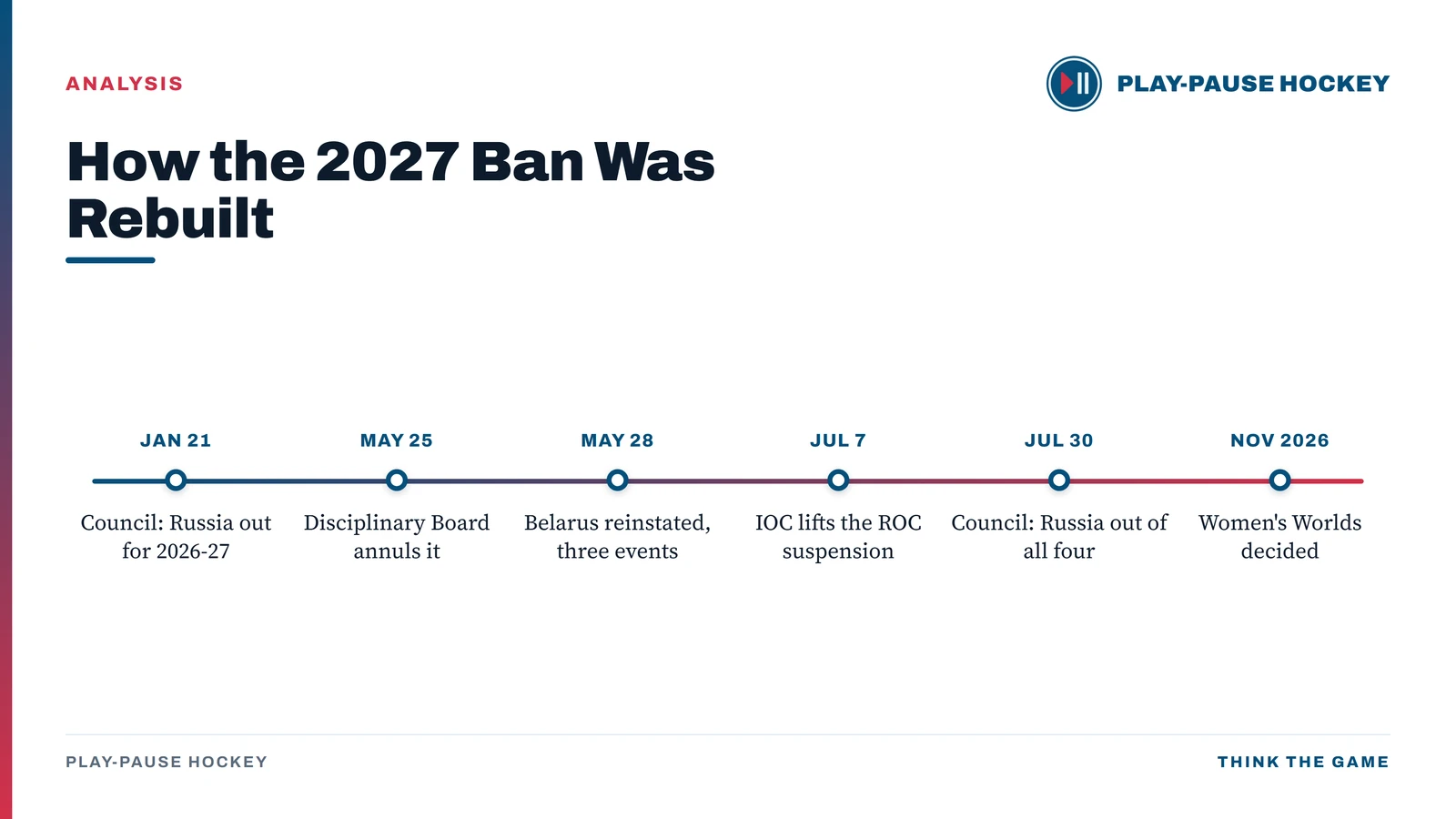
The sequence matters. On January 21 the IIHF Council decided Russia would not be reintegrated for the 2026-27 season, on safety and security grounds. The Russian Ice Hockey Federation appealed to the IIHF Disciplinary Board. On May 25 the Board annulled that decision, finding that the risk-assessment reports behind it did not provide enough specific justification to keep a blanket season-long suspension in place. It sent the file back to the Council to re-analyze, championship by championship, against safety, security, operational and sporting plans.
Per TSN and Pro Hockey Rumors, the Board also stated explicitly that annulling the ban did not mean Russia was automatically reintegrated.
Now read the July 30 statement with that in hand. “At a recent meeting, the Council reviewed and discussed the assessment of each individual IIHF Championship separately, considering safety, security, operational feasibility and sport integrity in relation to the RIHF’s requested participation.” That is the Board’s own test, returned with the same answer attached to each of the four championships the Council ruled on.
Why Edmonton in December Is the Part That Reaches the NHL
Three of those four tournaments are junior or under-18 events, which is where this stops being a governance story and starts being a hockey one.
The 2027 World Junior Championship runs December 26 to January 5 at Rogers Place in Edmonton and the Marchant Crane Centrium in Red Deer. It is a Canadian tournament, on the NHL calendar’s holiday window, in the middle of the 84-game schedule the league is skating for the first time since 1993-94. Russia will not be in it. Russian teams have been out of IIHF competition since 2022.
That absence is not abstract for NHL front offices. Three Russians went in the first round of the 2026 draft, in the same round that opened with Toronto’s No. 1 pick: Ilia Morozov 20th to Buffalo, Gleb Pugachyov 26th to Montreal and Maksim Sokolovskii 27th to Philadelphia.
Now note where each of them was playing. Morozov was at Miami of Ohio in the NCAA. Sokolovskii was with the London Knights in the OHL. Scouts watch those two constantly. Pugachyov is the one who stayed home, and he went to Montreal off a professional debut with Torpedo Nizhny Novgorod in the KHL.
That split is the actual shape of the problem, and it is why the World Juniors matters here beyond the flag. A prospect who crosses to North American junior or college hockey gets graded against the players he will be drafted alongside, every week. A prospect who stays inside the Russian system gets graded on KHL video against a different field. The World Juniors used to be the one event where both groups were measured on the same ice in the same week. Twenty-five Russians were drafted this June. None of them have had that tournament available since 2022, and it will not be available in Edmonton either.
Belarus Got Its Answer in Three Days. Russia Waited Two Months.
The same May 25 Board decision covered Belarus. Three days later, on May 28, the Council reintegrated Belarus for three events: the under-18 men’s World Championship in Duluth, Women’s Worlds Division IV, and Women’s Under-18 Division IIIB. The IIHF’s stated reason was that reintegration at that level “can be done in a safe, responsible, and controlled manner.” Belarus remains barred from the 2027 men’s World Championship.
Russia’s answer to the same order arrived on July 30.
In between, the ground moved. On July 7 the International Olympic Committee provisionally lifted its suspension of the Russian Olympic Committee, and stated that its recommendations to international federations regarding Russian athletes’ participation were no longer applicable. Whatever the IIHF decided after that date, it was deciding on its own account.
The Russian federation’s position is on the record and predates the ruling it now applies to. In a statement dated January 22, responding to the original Council decision, the RIHF called the safety argument “no longer relevant, lacks any basis, and is merely a formal pretext,” and said it would take the matter to the Court of Arbitration for Sport. It has said it is appealing the July 30 decision there as well. The IIHF’s position is the one quoted above: four criteria, weighed per championship.
The Council Did Exactly What the Board Ordered
Here is the objection, and it is the right one.
The Disciplinary Board never ordered anybody back onto the ice. It said so itself. It ruled that the January decision could not stand in the form it was written, not that its conclusion was wrong, and it told the Council to do the work properly. The Council went away for two months, did an event-by-event analysis against the criteria it was given, and landed in the same place. Reaching the same conclusion through a better process is not process failing. That is precisely what an appeal is supposed to be able to produce.
That concession is total, and it is why this is not a bad-faith story. Nobody here is owed an outcome.
What survives it is narrower. The Council can differentiate when it decides to, and it demonstrated that twice: Belarus at three events but not the men’s Worlds, and Russia’s women’s World Championship in Quebec City carved out for a separate look in November. Differentiation was available and used. What is missing is the event-specific reasoning the Board asked for. It does not appear in the IIHF’s public statement, and it is not in the July 30 coverage from ESPN, The Hockey News or the wire services. We have the four criteria that were weighed and the four results. The step in between, the thing the annulment was actually about, is the part that has not been shown.
The IIHF president has been on the other side of this in public. At the Milan-Cortina Olympics in February, Luc Tardif said: “We want as soon as possible Belarus and the Russians back.”
November Is the Next Real Test
The women’s World Championship in Quebec City is the open file, and the Council said it will handle it separately in November. The IIHF has also indicated it will consider reintegrating under-18 players for the 2027-28 season, subject to the same ongoing safety and security assessment.
So there are two things worth watching, and neither is the verdict.
The first is whether November’s decision ships with published, event-specific reasoning, or with another four-item criteria list. The Board’s finding in May was about a lack of specificity, and the cheapest way to keep that finding from repeating is to show the work. The second is CAS. If the Russian federation’s appeal is heard on the merits, the question in front of the arbitrators will not be whether Russia should play. It will be whether the second decision is better argued than the first one, which is the question the Disciplinary Board asked in May.