

Three proclamations signed on July 20 put an additional 50% duty on a long list of Canadian goods, and the coverage all landed on the same detail: hockey sticks are on it.
They are. We went into the annex and found the line. Ice hockey sticks sit at classification 9506.99.25, inside subdivision (b), which is the list of covered goods, and not subdivision (c), which is where the exclusions live. It takes effect at 12:01 a.m. eastern time on August 19.
Here is the part nobody reported. That line is not filed in some sporting goods measure. It sits inside the proclamation on alcoholic beverages, between coated paper and basketwork, which is what a retaliation list looks like from the inside.
And it will still barely touch the sport, for a reason that has nothing to do with hockey.
Why a Canadian Brand Is Not a Canadian Good
Customs law asks one question about any imported item: where was it made, or where did it last undergo substantial transformation. Not where the company is headquartered. Not where the founder was born.
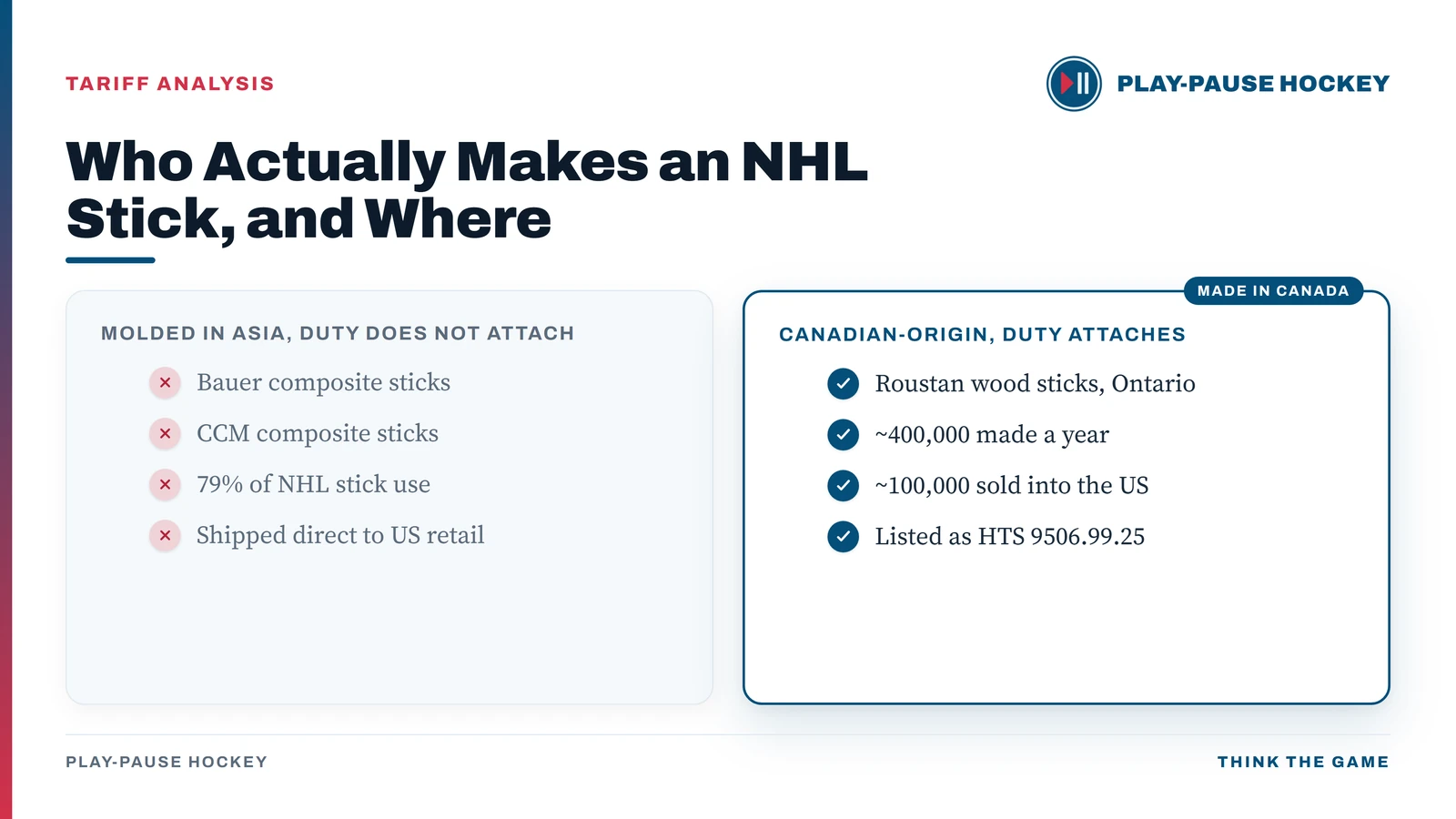
Run that test on the modern composite stick and the answer is not Canada. Bauer, the most Canadian-feeling brand in the sport, runs its global headquarters out of Exeter, New Hampshire and makes custom sticks and certain apparel through manufacturing partners in Asia. CCM is headquartered in Montreal, owned by Altor Equity Partners through Sport Maska, and follows the same pattern across much of its lineup. Those sticks are molded overseas and shipped straight to US retailers. They never cross the Canadian border into the US, so they are not Canadian imports, and the duty does not attach.
Classification, subdivision and effective time read directly from Annex II to the proclamation on alcoholic beverages, July 20, 2026. The substantial-transformation reading and the GearGeek shares per Newsweek, July 21, 2026. Headquarters, ownership and manufacturing per Romana King, Yahoo Finance, July 22, 2026. The 79% figure is ours, added from GearGeek's two published brand shares.
There is a wrinkle that cuts against the reassurance. Newsweek notes that sticks molded in China dodge the Canadian duty only to land in a different one, since US duties on Chinese goods, including any relevant Section 301 measures, apply on their own terms and always did. The composite stick was never insulated from trade policy. It was insulated from this trade policy.
One more detail worth knowing, because it is the question a reader actually has. The note carries a carve-out for “products for personal use included in accompanied baggage of persons arriving in the United States.” Drive back from a Canadian pro shop with a stick in the trunk and you are not the target of any of this.
One Ontario Factory Is Most of the Canadian Exposure
So who does pay it?
Roustan Hockey, in Ontario, runs what Reuters calls the only major ice hockey stick factory left in Canada. It turns out about 400,000 wood sticks a year and ships roughly 100,000 of them into the United States. A quarter of one plant’s output is the realistic scale of the Canadian-origin stick trade, and wood sticks have been in decline for years.
That is not nothing to the people who work there. It is close to nothing at the level the headlines implied.
There is a simple reason the stick got the coverage anyway. A stick is legible. Everyone can picture one, and the number attached to it, 9506.99.25, sounds specific enough to feel consequential. Reading which subdivision it sits in is more work than a same-day story allows.
The Case That This Costs Nobody Anything
The obvious pushback, and the first thing a reader will type: fine, my stick does not get more expensive, this is a nothing story.
On the narrow point, that is right. If you are buying a Vapor or a Ribcor this fall, this proclamation is not what moves the price.
The trouble is that manufacturers do not price line by line by country of origin. They price a book of business, and they price uncertainty. There is a live precedent, from a smaller and narrower tariff round in 2025:
April 2025, a different and smaller measure, and a projection rather than a receipt. Take it for exactly that. But it is the closest thing to evidence anyone has about how this industry answers a partial cost shock, and the answer was not “absorb it quietly inside the exposed category.” It was a number applied to products.
The timing does not help either. Manufacturers place 2026-27 season orders now, in July, ahead of an August 19 start date that both governments are treating as room to talk. Washington frames the measures as a response to Canadian duties on US autos, dairy and alcohol. Ottawa has said it remains ready to negotiate. Neither side’s account of who started what changes the customs arithmetic, but nobody sourcing inventory this month knows what the landed cost will be in September, and uncertainty during a buying window has its own price.
This is also the second time in one July that the business of the sport has handed fans a bill with no ice involved, after the NHL’s regional broadcast collapse left four markets without a channel.
What to Watch Before August 19
Bauer, CCM, Sherwood, the NHL, the NHLPA and Hockey Canada have said nothing publicly that appears anywhere in the coverage of the announcement, and Roustan Hockey did not respond to Reuters. Thirty days is not long to stay quiet.
Two things decide whether this stays symbolic. Whether the August 19 date survives the window at all. And whether rules of origin tighten, because the entire exemption keeping composite sticks cheap rests on a legal test a later proclamation could rewrite. That is the real risk here, and it is not the one on the front page: not the 50% on a line item, but a change to what counts as Canadian in the first place.
Until then, the honest read is this. The line in the annex is real, and we found it. The stick it describes is one that Canada, for the most part, stopped making a long time ago.