

The $19.1M Belongs to a Columnist, Not to an Agent
By Monday morning it was a bombshell. Matthew Schaefer, 18 years old, one season into his career, priced at $19.1 million a year, more than any player in the history of the sport has been paid.
Trace it back and it shrinks to a single sentence. Andrew Gross of Newsday, who covers the Islanders, wrote that a hypothetical five-year, $95.5 million contract might be enough to keep Schaefer when he becomes extension-eligible next July. That is a beat writer doing arithmetic off Celebrini’s record extension, not a report of an offer, a leak from the player’s camp, or the output of a cap model. Pro Hockey Rumors carried it. HockeyBuzz made it a bombshell. Dose.ca went further and floated $20 million. Nobody along that chain added a source. The number only got louder.
The August 3 HockeyBuzz rumor roundup that put the figure in front of most readers does not source it either.
So treat the reporting as what it is, and argue the number on its merits instead.
Ours: it holds. Not because anyone has confirmed it, but because the only honest way to price a contract that begins two cap years from now is share of the ceiling. By that measure $19.1 million is smaller than the headline implies and larger, in cap share, than any defenseman second contract in the public signing records.
The Comparison to Celebrini Is Off by a Cap Year
Every version of this story runs the same line: $19.1 million would top Macklin Celebrini’s $18.8 million, the largest cap hit ever agreed to. True in dollars. Useless as analysis.
Celebrini’s extension begins in 2027-28, against a ceiling the league has already set at $113.5 million. Schaefer’s entry-level deal, a three-year contract carrying a $975,000 cap hit, runs through 2027-28. He cannot sign an extension until July 1, 2027, and the first season any extension covers is 2028-29.
Two different denominators, two seasons apart. Comparing the raw AAVs is the same error as comparing a 1997 salary to a 2026 one and calling the difference inflation-proof.
Hold the year constant and the picture inverts. Celebrini takes 16.6 percent of the cap in the season his deal starts. Schaefer, at $19.1 million against a projected $123 million ceiling in the season his would start, takes 15.5 percent. The record-breaking number is the cheaper contract.
No Defenseman Who Reset This Market Ever Reached 14 Percent
Here is where the projection stops looking modest.
Four second contracts defined what a young star defenseman could command. Drew Doughty signed eight years at $7 million in 2011, against a $64.3 million cap: 10.9 percent. Erik Karlsson took $6.5 million in 2012: 9.3 percent. P.K. Subban’s arbitration-forced $9 million in 2014 was the high-water mark at 13.0 percent of a $69 million ceiling. Cale Makar matched the dollars in 2021 against a flat, pandemic-frozen $81.5 million cap: 11.0 percent.
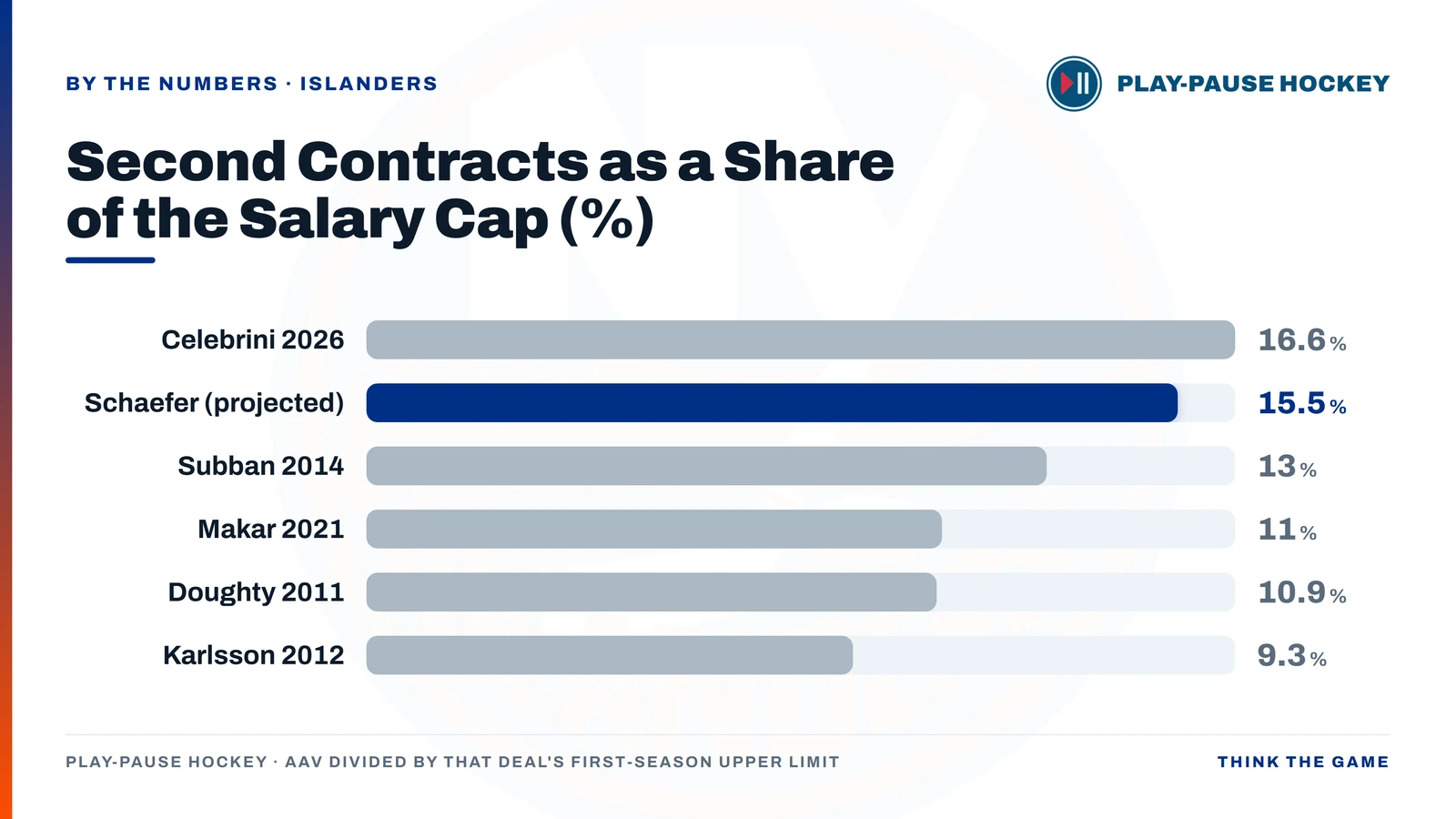
None of them reached 14 percent. Subban’s 13.0 is the ceiling, and we could not find a defenseman who beat it on a second contract anywhere in the public signing records. The Schaefer projection clears Subban by two and a half points on the conservative denominator, and by nearly four on the strict one.
Put it in dollars, which is where it stings. For Schaefer’s deal to claim only the share Subban claimed, against a $123 million cap, it would have to come in at $16.0 million. The projection sits $3.1 million above that line every season for five years.
The number is not historic because it beats Celebrini. It is historic because the biggest slice a defenseman has ever taken on a second contract is Subban’s 13 percent.
That is the actual claim buried under the bombshell framing, and it is a defensible one. Schaefer played all 82 games as an 18-year-old, scored 23 goals, put up 59 points, finished plus-13 and won the Calder unanimously. The goal total tied the NHL record for a rookie defenseman. There is no modern comparable for the season, which is precisely why there is no comparable for the contract.
The Cap Year His Deal Would Occupy Does Not Officially Exist
The right objection comes first: the 2028-29 ceiling is not set. The $123 million figure comes from agent projections of hockey-related revenue, not from the league, and the whole cap-share argument rests on a number nobody has ratified.
Correct, and worth conceding rather than dodging. But the argument survives the concession, because the conclusion does not depend on which denominator you pick. Run the projection against the official, already-announced 2027-28 ceiling of $113.5 million and $19.1 million is 16.8 percent, higher still. The cap-share verdict gets stronger under the conservative assumption, not weaker. Only a ceiling above roughly $147 million would drag it back under Subban’s 13.0 percent, and nobody is projecting that.
The second objection has better legs. Schaefer is not the negotiation happening this summer. Cale Makar remains unsigned in Colorado with the September 15 term deadline closing the eight-year window the day before the new CBA takes effect, and the Quinn Hughes extension in Minnesota is still stuck on term rather than dollars. Both are pegged in the $17 million to $18 million range by the insiders tracking them. Those two contracts, not a column, will establish what a franchise defenseman costs, and they will be signed a year before Schaefer can put a pen to anything. If the defenseman market reset lands at $17.5 million for two established Norris-tier players, a $19.1 million ask for a 19-year-old with two NHL seasons becomes a much harder sell.
What Would Have to Happen for $19.1M to Look Cheap
One thing, mostly: Schaefer has to keep being this.
A second season in the same range makes the number inevitable rather than aggressive, because by July 2027 the Islanders will be negotiating against a player with no ceiling anyone can locate and a cap climbing $9 million a year. Regression to a very good 45-point defenseman makes $19.1 million read as what it currently is, a columnist’s ceiling rather than a floor.
Watch two things before then. Whether Makar and Hughes land above or below $18 million, since that sets the roof Schaefer’s camp will try to lift. And whether the Islanders show any appetite for buying the extension early. They cannot sign it before July 2027, but the public posture of a front office that believes it is bidding against history usually leaks well before the contract does.
Schaefer, for his part, was asked about all of it at a charity golf tournament in July and gave the only answer an 18-year-old should give.
“I’ll let my agent think about that. I don’t need to think about that. I’m still a kid. I’m still a year away from any of that… I don’t care about the money. I just want to play the game of hockey and that’s what I love.”
He is right about the timeline. Everyone else has a year to argue about a number nobody has offered.